Research

Learning from systems whose important events are rare, complex or stochastic.

My research background combines physics-based simulation, numerical algorithms and data analysis—from atomistic rare events to DNA interactions and neuromorphic materials.

Go to publications

PhD research · 2021–2022

Atomistic Simulations, IIT

Research period in Michele Parrinello’s group, focused on atomistic simulations, enhanced sampling and data-driven descriptions of slow molecular processes.

Finding the slow modes behind rare events

Molecular simulations often cannot reach the timescales of infrequent but important events. Enhanced-sampling methods address this limitation by accelerating a small set of collective variables that capture the slow processes governing a transition.

Transfer-operator methods and machine learning provide a route to identify these slow modes from simulation trajectories. This methodology formed the scientific context of my PhD research period and connected statistical mechanics with modern data-driven modelling.

Methodological context

Deep-TICA for rare-event sampling

The Parrinello-group paper combines neural-network transfer operator eigenfunctions with enhanced sampling to learn effective collective variables from biased trajectories.

This paper is included as context for the group’s methodology; I am not one of its authors.

Bonati, Piccini & Parrinello, PNAS (2021)
  1. 01 Generate trajectories Collect configurations from an initial simulation.
  2. 02 Learn slow modes Analyse time-lagged dynamics with transfer operators.
  3. 03 Build collective variables Represent the processes that limit convergence.
  4. 04 Accelerate sampling Promote transitions and reconstruct the landscape.

Peer-reviewed work

Selected publications

Two collaborations in which I contributed directly to software, algorithms, simulations and scientific analysis.

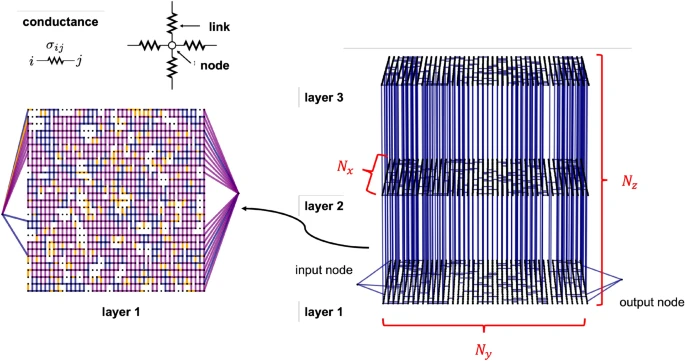
Diagram of a three-dimensional resistor network with nodes, links and conductances
Network model from Mambretti et al., Scientific Reports 12, 12234 (2022), licensed under CC BY 4.0.

Scientific Reports · 2022

Dynamical stochastic simulation of complex electrical behaviour in neuromorphic networks of metallic nanojunctions

We developed a large three-dimensional resistor-network model with non-linear conduction and stochastic conductance updates. At sufficient scale, the model qualitatively reproduces electrical behaviours observed in nanostructured gold films and supports their study as neuromorphic systems.

My contribution

Co-conception of the algorithm; development, implementation and testing; simulations, data processing and analysis.
Read the publication
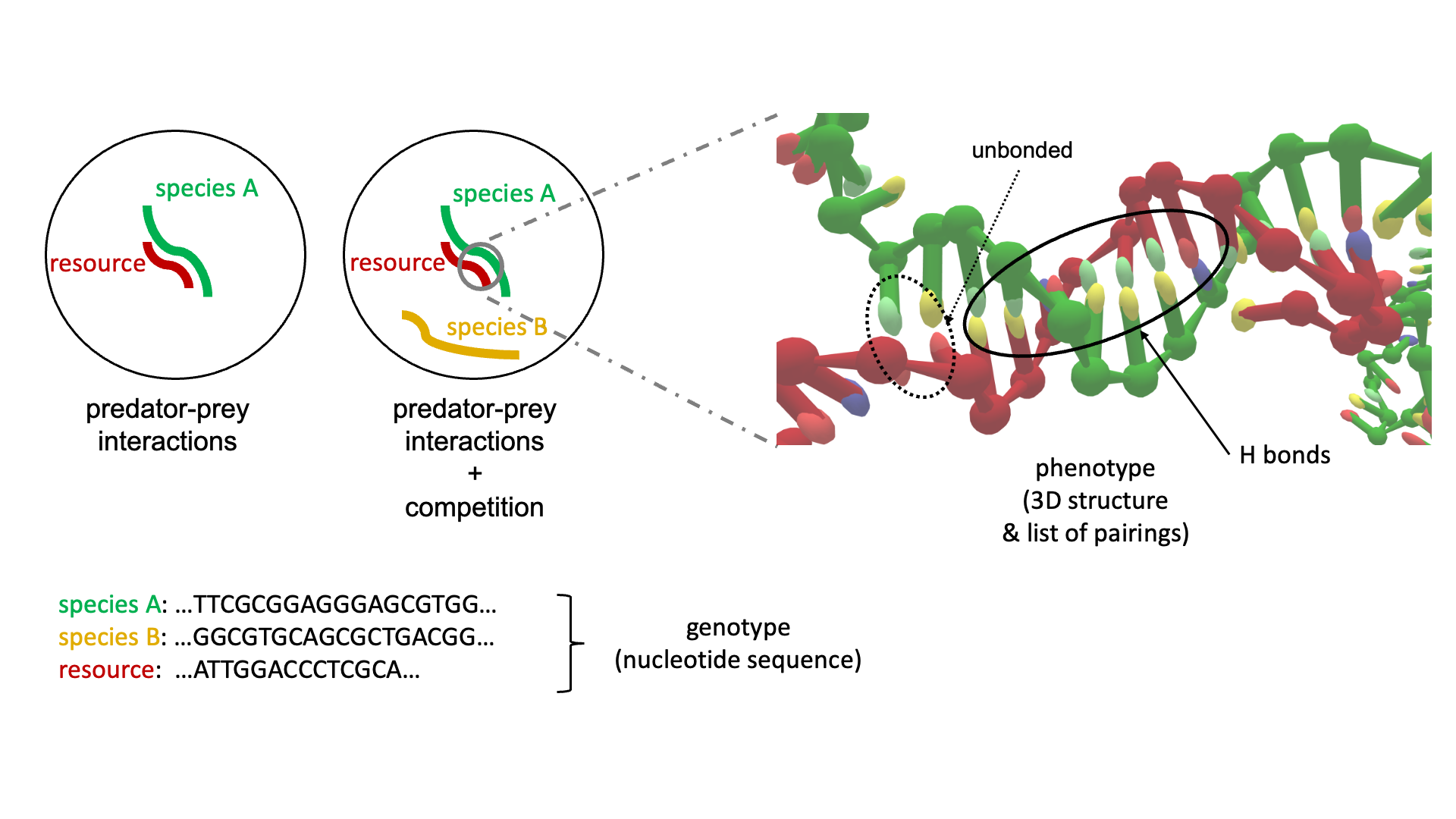
Concept diagram showing DNA strands as competing species and resources in an artificial ecosystem
DNA ecosystem concept from Mambretti et al., Entropy 24, 458 (2022), licensed under CC BY 4.0.

Entropy · 2022

OxDNA to Study Species Interactions

We used coarse-grained molecular dynamics to model single-stranded DNA oligomers as species competing for resource strands. Simulations and experiments explored how sequence overlap and three-dimensional structure influence competitive advantage.

My contribution

Software development, methodology and investigation, including the molecular simulations used to study competitive and cooperative interactions.

Read the publication

Education

A foundation in physics

2019–2021

M.Sc. in Physics

University of Milan · 110/110 cum laude

2015–2018

B.Sc. in Physics

University of Milan · 110/110 cum laude

2021–2022

PhD research period

Italian Institute of Technology · Former PhD candidate

Continue exploring

Research is one part of the story.

See how this foundation now informs applied R&D, computer vision and system engineering.